



| Quantity: | |
|---|---|


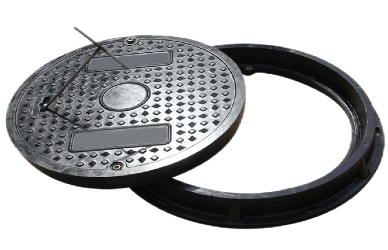
The Elite SMC Composite Manhole Cover is developed for underground access points in fuel stations, forecourts and other service areas where conventional metal covers may be exposed to moisture, fuel-related contaminants and repeated vehicle loading.
The cover is manufactured from Sheet Molding Compound (SMC) using a controlled compression-molding process. The molded composite structure provides a combination of mechanical strength, dimensional stability and resistance to corrosion while reducing the handling weight compared with many traditional cast-iron alternatives.
The cover and frame are supplied as a matched set and can be configured for different traffic conditions, access requirements and project specifications.
Typical applications include fuel station utility chambers, drainage access points, electrical service pits and underground maintenance chambers.
The MR600 series is available in four load configurations to accommodate different installation environments.
| Model | Load Class | O (Opening) mm | D mm | F mm | h mm | H mm | Approx. Weight |
|---|---|---|---|---|---|---|---|
| MR600A | A15 | 550 | 600 | 705 | 30 | 50 | 16.6 kg |
| MR600B | B125 | 550 | 600 | 705 | 30 | 50 | 19.9 kg |
| MR600C | C250 | 550 | 600 | 705 | 50 | 70 | 26.9 kg |
| MR600D | D400 | 550 | 600 | 705 | 50 | 70 | 32.5 kg |
Note: Load classification and product configuration should be selected according to the actual installation location, traffic conditions and applicable project standard.
Sheet Molding Compound combines thermosetting resin with reinforcing fibers and other functional fillers. After compression molding, the material forms a rigid composite structure suitable for demanding infrastructure applications.
The cover is produced under controlled temperature and pressure conditions. This process allows the material to form the required cover geometry while maintaining consistent dimensions across production batches.
Compared with conventional exposed steel or cast iron products, the SMC structure does not depend on a metallic surface coating for basic corrosion protection.
This makes the product suitable for outdoor and underground access points where water, humidity, salts and other environmental contaminants may be present.
Gas station manhole covers can be installed in areas containing different types of underground utilities and service systems.
The MR600 series can be considered for:
Fuel station utility chambers
Underground electrical access points
Drainage and wastewater chambers
Oil-water separation system access
Service and inspection pits
Communication and control cable chambers
Forecourt utility infrastructure
Underground pipeline service areas
Commercial vehicle service facilities
Other road-side utility access points
For areas exposed to vehicle traffic, the required load class should be determined according to the actual traffic pattern and installation conditions.
The SMC material is inherently resistant to rust and suitable for environments where prolonged exposure to water and humidity can affect conventional metal products.
The MR600 series ranges from approximately 16.6 kg to 32.5 kg per cover and frame set, depending on the load class. The reduced weight can make transportation, positioning and routine removal more manageable.
Four load classes are available within the MR600 range, allowing the product to be selected according to pedestrian areas, service zones and vehicle-accessible locations.
Compression molding produces a one-piece composite cover structure with controlled geometry and repeatable dimensions, supporting consistent installation across larger project quantities.
The composite construction provides electrical insulation characteristics and can be considered for utility chambers containing electrical or communication infrastructure.
Surface markings, logos and other identification requirements can be incorporated depending on the product configuration and order quantity.
Elite applies quality inspection throughout the manufacturing process rather than relying only on a final visual inspection.
Production control may include:
Incoming Material Control
Raw materials and SMC compounds are checked before entering production.
Molding Process Control
Molding parameters are monitored to maintain product consistency and dimensional stability.
Dimensional Inspection
Finished covers and frames are checked against the approved product specifications.
Appearance Inspection
The surface, edges, markings and overall molding quality are inspected before packing.
Load Testing
Load performance can be evaluated according to the required product class and applicable testing requirements.
Pre-Shipment Inspection
Finished products are inspected before shipment, with inspection records and testing information available according to the order requirements.
The standard MR600 series covers common 600 mm access requirements. For projects requiring different dimensions or structural configurations, Elite can manufacture customized composite covers.
Customization can include:
Cover dimensions
Clear opening
Frame dimensions
Load class
Cover geometry
Surface pattern
Customer logo
Product identification
Color
Locking arrangement
Packaging
For a new design, customers can send a 2D drawing, 3D drawing, existing sample or dimensional specification for engineering review.
Elite New Materials has specialized in composite molded products and SMC manufacturing since 2004, with the export business operating under the Elite brand since 2019.
Our manufacturing background covers SMC/GRP products for infrastructure, utilities, telecommunications, electrical and municipal applications.
Our production system supports compression molding and customized composite product development, allowing standard products and project-specific designs to be manufactured within the same supply chain.
Quality management and production documentation can be provided according to customer and project requirements, including relevant inspection records, technical documentation and product testing information.
Elite supplies composite infrastructure products to overseas customers and supports OEM development, sample approval, bulk production, export packing and international shipment.
Each cover and frame set is prepared for international transportation with protective packaging designed to reduce movement, scratching and surface damage during handling.
Typical export packaging includes:
Protective plastic film
Bundled or palletized loading
Wooden pallets where required
Product identification labels
Export shipping marks
Before dispatch, the order quantity, product model and packaging condition are checked by the production and quality teams.
Shipping arrangements can be made by sea, air or other suitable transportation methods according to the order quantity and destination.
A typical customized order follows these stages:
1. Requirement Confirmation
Customer provides dimensions, load class, quantity, application and destination.
2. Technical Review
Our team checks the requirements and confirms the appropriate model or proposes a customized design.
3. Quotation
Pricing, tooling cost where applicable, packaging, lead time and shipping terms are provided.
4. Sample Approval
A sample can be produced for projects requiring dimensional or technical approval.
5. Mass Production
Production begins according to the approved specification and agreed payment terms.
6. Quality Inspection
Finished products undergo final inspection before packing.
7. Shipment
Products are packed and dispatched according to the agreed shipping arrangement.
The MR600 series is manufactured from Sheet Molding Compound (SMC), a fiber-reinforced thermosetting composite material processed through compression molding.
The appropriate class depends on the location and expected traffic. A15 is generally intended for pedestrian-type areas, while higher classes such as B125, C250 and D400 are available for progressively more demanding loading conditions.
The final selection should follow the project specification and actual site conditions.
Yes. The SMC composite construction is suitable for many gas station utility and service chambers, particularly where resistance to moisture, corrosion and repeated outdoor exposure is required.
The standard MR600D configuration listed above weighs approximately 32.5 kg per cover and frame set.
Yes. OEM marking and customized logos can be incorporated according to the product design and order quantity.
Yes. Customized dimensions can be developed based on a customer drawing, existing sample or required clear opening.
Not necessarily. Our engineering team will first check whether an existing mold or configuration can meet the requirement. If dedicated tooling is necessary, mold development and cost will be quoted separately.
Yes. Samples can be supplied for dimensional checking, appearance evaluation and project approval.
Quality is controlled through material inspection, molding process monitoring, dimensional checks, appearance inspection and final inspection before shipment. Load testing can also be arranged according to the applicable product requirement.
For standard export orders, the usual arrangement is 30% deposit by T/T before production and 70% balance before shipment, subject to the final commercial agreement.
Lead time depends on the model, order quantity, mold availability and customization requirements. A confirmed production schedule will be provided with the quotation.
For a new design, tooling development is typically around 20–30 days, depending on the complexity of the mold and the approval process.
The MR600 SMC Composite Manhole Cover range provides four load-class options for different access locations, from pedestrian areas to vehicle-accessible zones.
Its combination of SMC composite construction, controlled compression molding, reduced handling weight and resistance to corrosion makes it suitable for gas stations and other utility infrastructure where conventional metal covers may require greater protection against environmental deterioration.
For a quotation, send us the required opening size, load class, quantity and project location. For a non-standard design, a drawing or existing cover sample will help us evaluate the appropriate solution.
