
Views: 0 Author: Site Editor Publish Time: 2026-09-20 Origin: Site


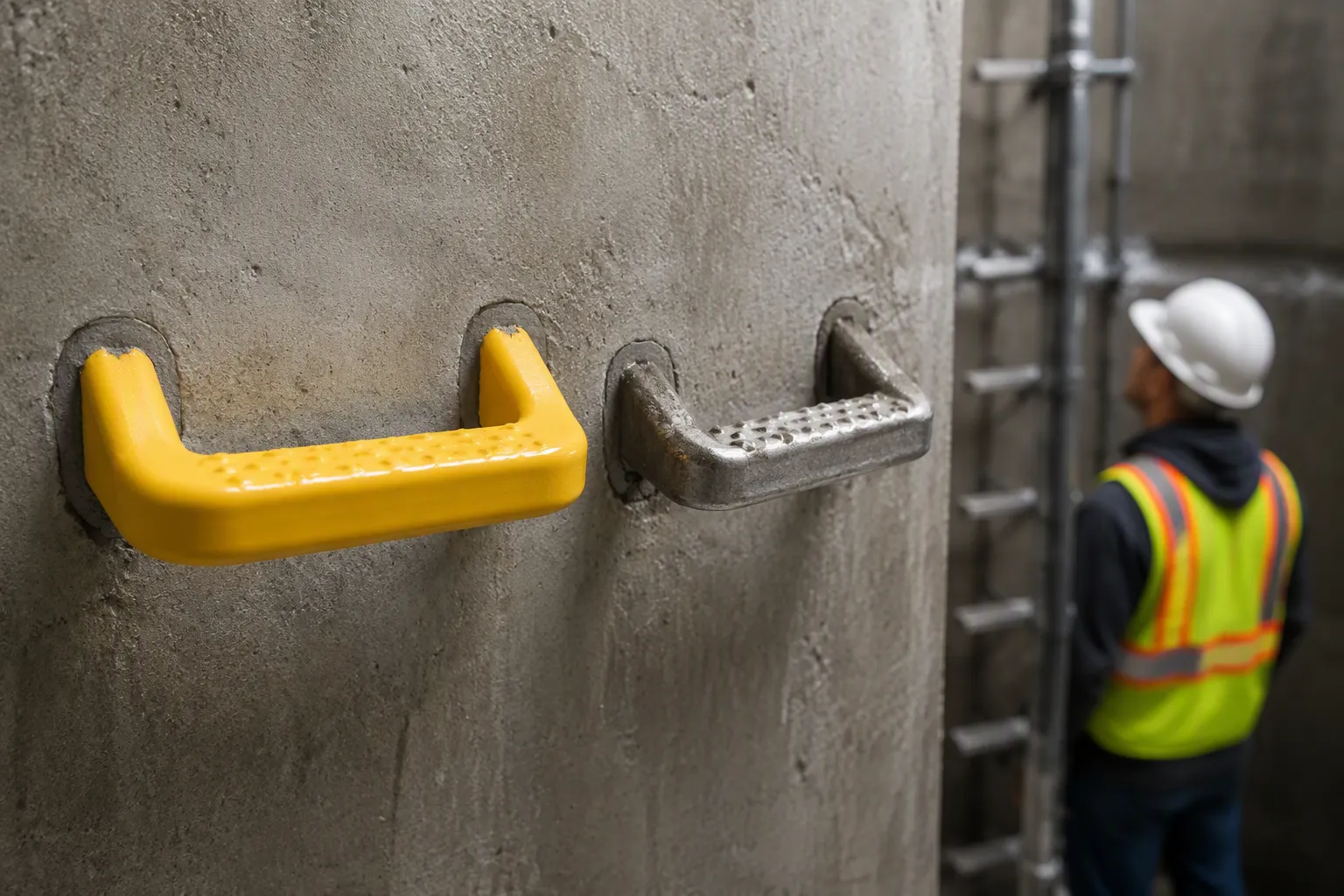
PP-coated steel and stainless steel manhole steps use two different approaches to underground durability. PP-coated steel combines a structural steel core with a polymer barrier that separates the metal from moisture and contaminants. Stainless steel relies on the corrosion resistance of the alloy itself rather than an external protective layer.
Neither approach is automatically better for every chamber. Sewer conditions, chloride exposure, industrial chemicals, temperature, step geometry, project standards, maintenance access, and budget can all influence the specification. This comparison focuses on the material differences between PP-coated steel and stainless steel manhole steps so project teams can evaluate which construction better matches a particular underground access environment.
PP-coated steel manhole steps protect a steel core with an external polymer barrier, making coating integrity an important part of long-term performance.
Stainless steel obtains corrosion resistance from its alloy composition and does not depend on a polymer coating remaining intact.
Grade 316 stainless steel generally offers better resistance to chloride-induced pitting than 304, but the required grade should follow actual exposure and project specifications.
Slip resistance depends on tread and surface design rather than material name alone. Both constructions can be designed with textured surfaces for underground access.
Purchase price should be considered together with expected exposure, inspection requirements, replacement difficulty, and lifecycle cost.
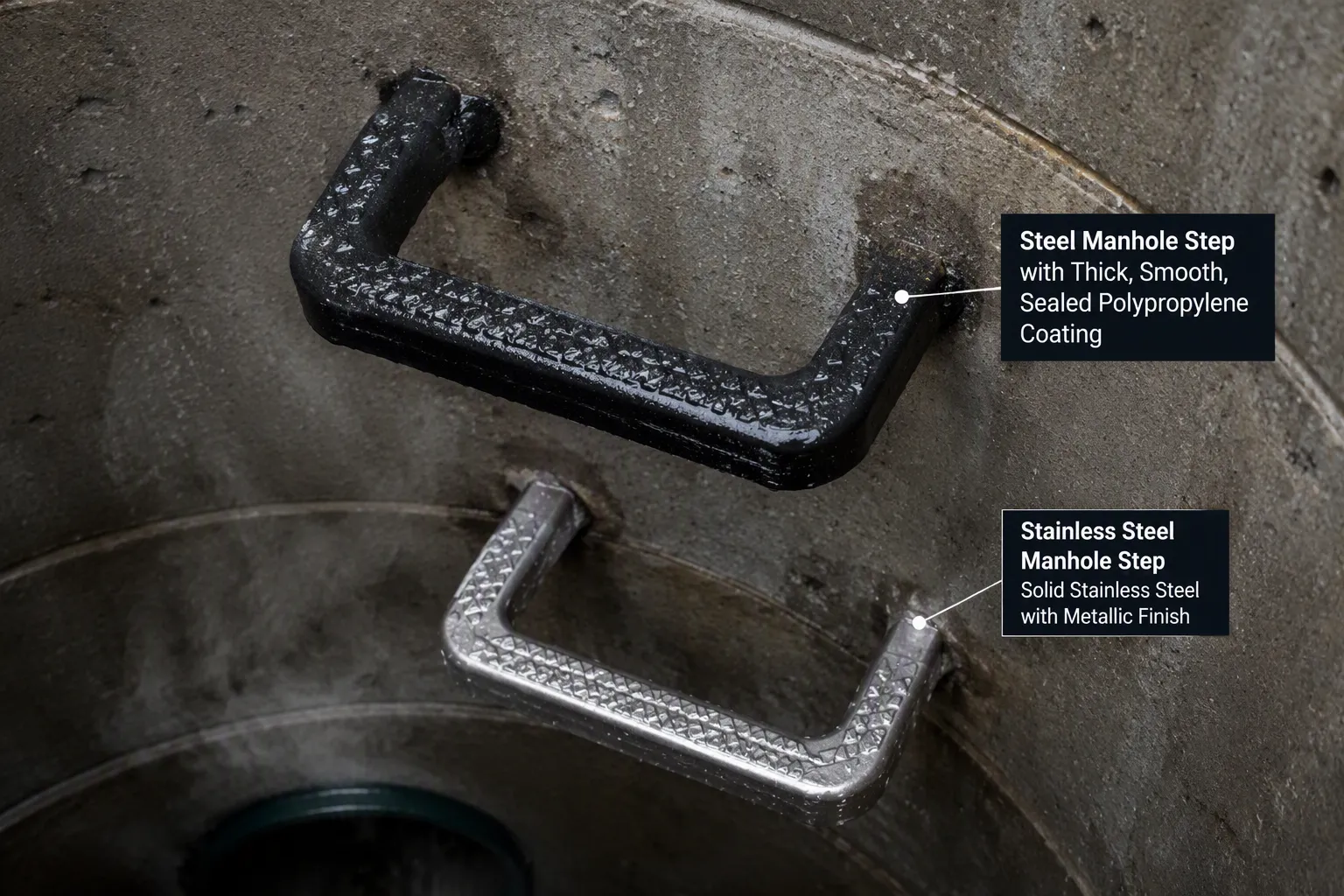
Corrosion resistance is one of the main reasons these two constructions are compared for underground access. The important difference is not simply “plastic versus metal.” It is the way each step prevents the structural component from deteriorating when exposed to water, wastewater gases, chlorides, or other contaminants.
A PP-coated manhole step places a polypropylene surface around a steel core. When the coating remains continuous, it limits direct contact between the steel and the surrounding chamber environment. This construction allows the steel core to provide mechanical support while the molded polymer surface provides environmental separation and can incorporate a textured tread.
This type of construction is commonly considered for wastewater, drainage, and utility access where moisture and corrosive contaminants make exposed carbon steel less desirable. The actual suitability of the step still depends on the polymer formulation, coating quality, geometry, expected exposure, and project requirements.
The coating also changes the exposed surface characteristics of the product. For example, molded ribs, dimples, or other textures can be integrated into manhole steps to improve foothold in wet underground conditions.
Coating integrity is therefore a key inspection point. Deep cuts, cracking, impact damage, or exposed steel can reduce the protective function of the encapsulation. Products should be inspected before installation and during service according to the applicable maintenance program.
Stainless steel takes a different approach. Instead of placing a polymer barrier around carbon steel, corrosion resistance comes from the alloy itself. Austenitic grades such as 304 and 316 are widely used across industrial and infrastructure applications, although exact grade selection should follow the expected environment and project specification.
The difference becomes especially relevant when chlorides are present. Grade 316 contains molybdenum, which generally improves resistance to chloride-induced pitting compared with 304. For that reason, 316 may be considered in more demanding chloride environments such as certain coastal, marine, de-icing salt, or industrial applications.
That does not mean every coastal chamber automatically requires 316 or that 304 is unsuitable in every such project. Chloride concentration, temperature, wetting conditions, contaminants, cleaning regime, fabrication, and expected service life all affect corrosion behavior.
Because stainless steel does not depend on a polymer barrier, localized scratching does not expose a carbon-steel core in the same way it can with a coated product. However, stainless steel is not immune to corrosion. Grade, fabrication condition, contaminants, and environmental exposure still matter.
For underground access projects, material should therefore be selected from the actual chamber conditions rather than from a simplified rule that one construction always outperforms the other. Our manhole access products are used across different infrastructure applications, and specifications should reflect the environment in which each component will operate.
Comparison Point | PP-Coated Steel | Stainless Steel |
|---|---|---|
Protection Method | Polymer barrier surrounding a steel core | Corrosion-resistant alloy throughout the component |
Key Inspection Point | Coating integrity and exposed steel | Pitting, deposits, surface contamination, deformation |
Chloride Exposure | Depends on polymer compatibility and coating integrity | Grade selection is important; 316 generally offers greater pitting resistance than 304 |
Surface Texture | Can be molded into the polymer surface | Can be formed, knurled, dimpled, serrated, or otherwise textured |
Cost Structure | Uses a carbon-steel core plus polymer coating | Depends heavily on stainless grade, dimensions, and fabrication |
Durability should not be reduced to a single material ranking. PP-coated steel and stainless steel can both provide long service when their construction matches the chamber conditions, but they respond differently to physical and environmental damage.
For a PP-coated step, long-term performance depends heavily on keeping the protective polymer layer intact. Normal contact during climbing is different from deep cutting, severe impact, abrasion, or damage caused by improper handling. Once the steel core becomes exposed, the local corrosion behavior changes.
This makes coating quality and geometry important procurement factors. Buyers should review the specified polymer, coverage, molded tread design, steel core construction, and any relevant product testing rather than assuming that all coated steps perform the same way.
Stainless steel does not rely on a separate protective coating, but performance still varies according to alloy grade and environment. Chlorides can cause localized pitting, while chemical contamination, deposits, fabrication practices, and prolonged exposure can affect corrosion resistance.
Mechanical design remains just as important as material. A manhole ladder rung must provide appropriate geometry and load performance for the intended chamber. Stainless steel should therefore not be treated as a substitute for proper structural design or project-specific testing.
Underground access surfaces may be exposed to water, condensation, mud, wastewater residues, or other contaminants. For this reason, slip resistance is a product-design requirement rather than a benefit that comes automatically from choosing PP-coated steel or stainless steel.
For U.S. workplaces covered by OSHA 29 CFR 1910.24(b), manhole steps installed on or after January 17, 2017 must have a corrugated, knurled, dimpled, or other surface that minimizes the possibility of slipping. The regulation also requires the step to be designed and maintained so the user's foot is less likely to slip or slide off the end.
The molded polymer exterior of a PP-coated product allows ribs, dimples, and other grip features to be incorporated into the surface during manufacturing. The effectiveness of the tread depends on its actual geometry and condition rather than simply on the fact that polypropylene is present.
For example, our DIN 19555 PP-coated steel manhole step uses a molded polymer exterior around the structural core for underground access applications.
Our guide to PP coating for steel manhole steps explains the barrier concept in more detail.
A stainless steel step can also incorporate corrugation, knurling, dimples, serrations, or other surface features. Smooth stainless steel alone should not be assumed to provide adequate grip in a wet chamber.
The project team should review the finished step design, not merely the alloy designation. Tread geometry, usable width, projection, spacing, contamination, and inspection all influence climbing safety.
Installation requirements should be reviewed after the material and chamber conditions have been defined. The two constructions may differ in handling, fixing details, tolerances, and allowable field modification, but those differences depend on the actual product design.
For PP-coated products, unnecessary cutting or damage to the molded protective surface should be avoided unless the manufacturer specifically permits a field modification and provides an appropriate procedure. For stainless steel products, fabrication or site modification should likewise follow the specified grade, fixing method, and manufacturer instructions.
The installation method should not be improvised from the material name alone. Cast-in, drilled, anchored, or other configurations can require different hole sizes, embedment depths, substrates, tolerances, and installation procedures.
For detailed installation guidance, refer to our separate article on how to properly install manhole steps. Keeping installation guidance separate from this material comparison prevents the two specification decisions from being confused.
Material cost is an important procurement factor, but a simple statement that one construction is always cheaper can be misleading. Pricing varies with steel dimensions, polymer specification, stainless grade, fabrication, quantity, testing requirements, freight, and project-specific customization.
PP-coated steel uses a carbon-steel structural core together with a molded polymer exterior. Stainless steel uses a corrosion-resistant alloy throughout the component, and grades such as 304 and 316 have different raw-material costs.
This means stainless steel frequently carries a higher raw-material cost than carbon steel, while PP-coated products add their own coating and manufacturing processes. Actual quotation differences should therefore be compared using the same dimensions, quantities, load requirements, surface geometry, documentation, and delivery terms.
The same sourcing principle applies to other underground infrastructure products. Our article on materials used to make sewer grates explains why material category alone does not determine the final specification or procurement cost.
The more useful comparison is total service cost. A lower purchase price loses its advantage if a product is poorly matched to the exposure and requires premature replacement. Conversely, specifying a more expensive alloy where the environmental conditions do not require it may increase project cost without creating a proportional benefit.
Lifecycle planning should therefore consider expected corrosion exposure, likelihood of coating damage, inspection access, replacement difficulty, confined-space work requirements, downtime, and the expected service period of the chamber.
This is especially relevant to coastal and chloride-exposed infrastructure. Related environmental considerations are discussed in our article on composite drainage grates in coastal applications.
The material decision becomes clearer when the project team defines the exposure before requesting quotations. Start with the chamber environment rather than with a preferred material name.
Project Question | Why It Matters for PP-Coated Steel | Why It Matters for Stainless Steel |
|---|---|---|
Is the chamber persistently wet or chemically corrosive? | Check coating compatibility and integrity | Check alloy grade and corrosion mechanism |
Are chlorides present? | Review the polymer system and exposure conditions | Compare 304, 316, or other specified grades as appropriate |
Can the exposed surface be damaged by abrasion or impact? | Protective coating condition becomes important | No external polymer barrier to cut, but surface damage and deformation still require inspection |
What slip-resistant geometry is required? | Review molded tread design | Review knurling, corrugation, dimples, or other texture |
How difficult is future replacement? | Include coating damage risk and expected inspection cycle | Include alloy cost and expected corrosion exposure |
For example, a wastewater chamber with persistent moisture but limited chloride exposure may lead to a different specification from a coastal utility chamber exposed to saltwater intrusion. An industrial chamber containing process chemicals may require a separate compatibility review again.
If the main question is not material comparison but how sewer, stormwater, and utility environments change the specification, see our guide to manhole step requirements for sewer, stormwater, and utility chambers.
PP-coated steel may be considered when a project requires a steel structural core combined with a molded polymer barrier and integrated tread surface. The product specification should address coating condition, expected chemicals, moisture, dimensions, load performance, and installation requirements.
Stainless steel may be considered where project requirements favor corrosion resistance throughout the metal section rather than through external polymer encapsulation. In chloride-containing environments, the difference between stainless grades becomes particularly important.
Neither statement replaces a site-specific engineering specification. Chemical concentration, temperature, chamber construction, regulatory requirements, expected service life, and maintenance conditions should be reviewed before the final material is selected.
The practical difference between PP-coated steel and stainless steel manhole steps is therefore the protection strategy. PP-coated steel relies on an intact polymer barrier around a structural core. Stainless steel relies on the corrosion behavior of the selected alloy. Project teams should compare those strategies against the actual chamber exposure instead of treating either one as the universal winner.
This same application-first approach is useful throughout municipal infrastructure procurement. For another example, see our comparison of composite manhole covers and cast iron for municipal projects.
Not in every case. PP-coated steel can be appropriate when an intact polymer barrier is compatible with the wastewater environment and project requirements. Stainless steel may be preferred where the specification calls for corrosion resistance throughout the metal section or where the expected exposure makes a polymer coating less suitable. The chamber conditions should determine the comparison.
No. Grade 316 generally has better resistance to chloride-induced pitting than 304 because of its molybdenum content, but grade selection still depends on actual chloride exposure, wetting conditions, temperature, contaminants, expected service life, and project requirements. Coastal infrastructure should be evaluated by exposure rather than location name alone.
They can, provided the finished step design meets the applicable requirements. OSHA 1910.24(b)(2)(i) requires qualifying manhole steps to have a corrugated, knurled, dimpled, or other surface that minimizes slipping. A molded PP tread can provide this type of geometry, but compliance should be established from the actual product design and applicable documentation rather than from the coating material alone.
Yes. Stainless steel steps can be manufactured with knurled, corrugated, dimpled, serrated, or other textured surfaces. Slip resistance depends on the finished tread geometry and condition, not simply on whether the step is stainless steel.
There is no universal price difference that applies to every project. PP-coated steel uses a carbon-steel core plus a molded polymer system, while stainless steel pricing varies significantly by grade and fabrication. Quantity, dimensions, testing, freight, customization, and documentation can also change the quotation. Compare equivalent product specifications rather than material names alone.
It can, but installation depends on the complete step design and chamber construction rather than the material alone. Avoid making field modifications without manufacturer guidance. Detailed fixing procedures should follow the relevant product instructions and chamber specification.


